

The cover drive is often called the most beautiful shot in cricket. Played well, it is a study in timing, balance and geometry. But what makes one work biomechanically, and what can pose analysis teach us about the mechanics separating a textbook stroke from a mistimed flash?
Deconstructing the Stroke: Five Phases
The cover drive breaks into five phases, each with markers that track closely with shot quality.
Phase 1: Stance and Trigger
The setup decides what is possible. Elite batters take a stance roughly shoulder-width, with weight slightly favouring the back foot at release so they can move either way. A small forward lean pre-loads the movement toward the ball without committing too early. These are old coaching principles, and pose data supports them.
Phase 2: The Stride and Weight Transfer
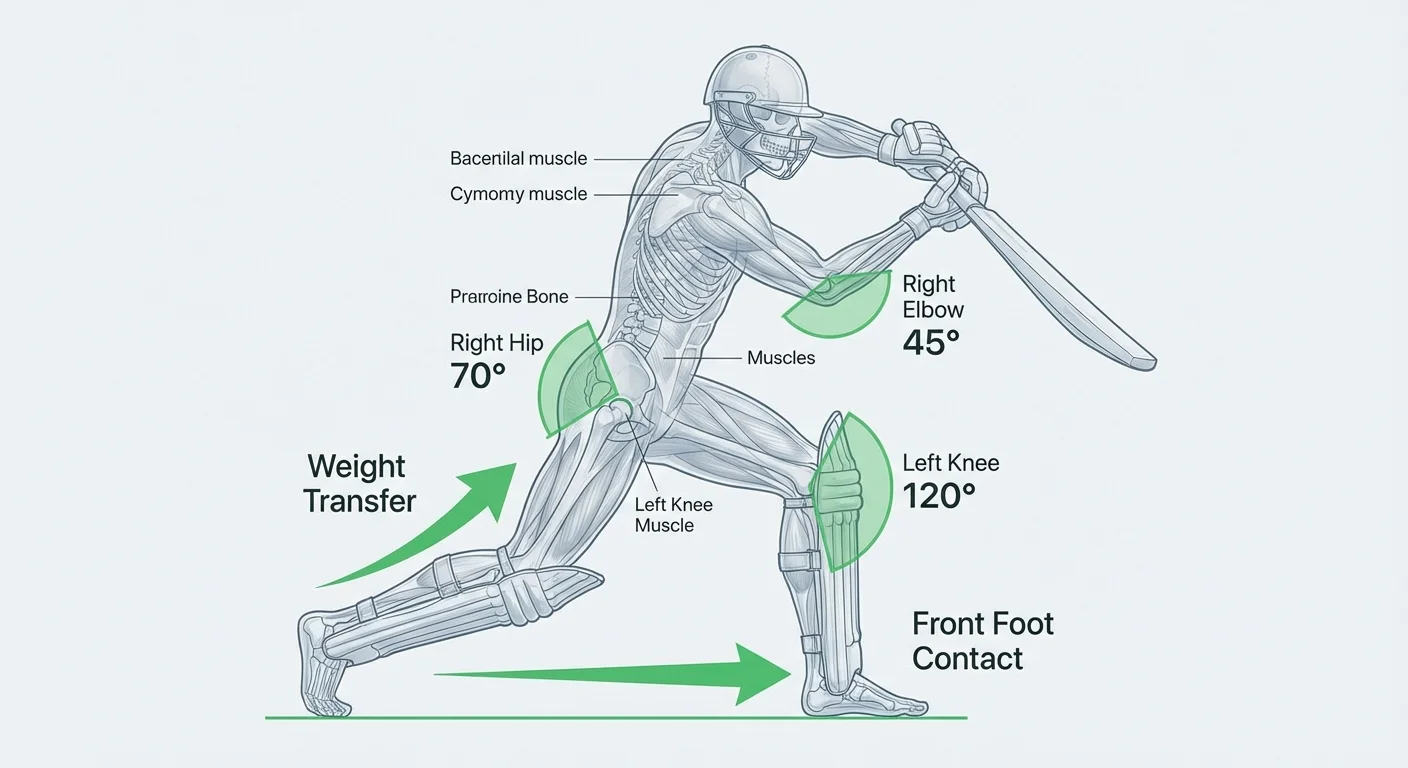
As the batter reads a cover-drive length, the front foot strides toward its pitch. For adults, a controlled stride with the front foot pointing toward the off side balances reach against stability.
Weight transfer is critical. In high-quality drives the weight shifts smoothly from back foot to front in a fraction of a second, and the front knee bends but stays braced. A knee that collapses usually means the batter has lunged — which costs balance and removes any chance of adjusting if the ball deviates.
Phase 3: The Backlift and Downswing
Backlifts fall into two patterns, looped or straight. Traditional coaching favours a straight backlift, though many elite players use a slight loop that generates extra bat speed through the hitting zone.
Whatever the backlift, the downswing is remarkably consistent among the best. The lead elbow angle at contact is one of the strongest signals of shot quality: a high, extended elbow correlates with clean striking, while a low, collapsed elbow shows up alongside mistimed shots, inside edges and lost power.
Phase 4: The Point of Contact
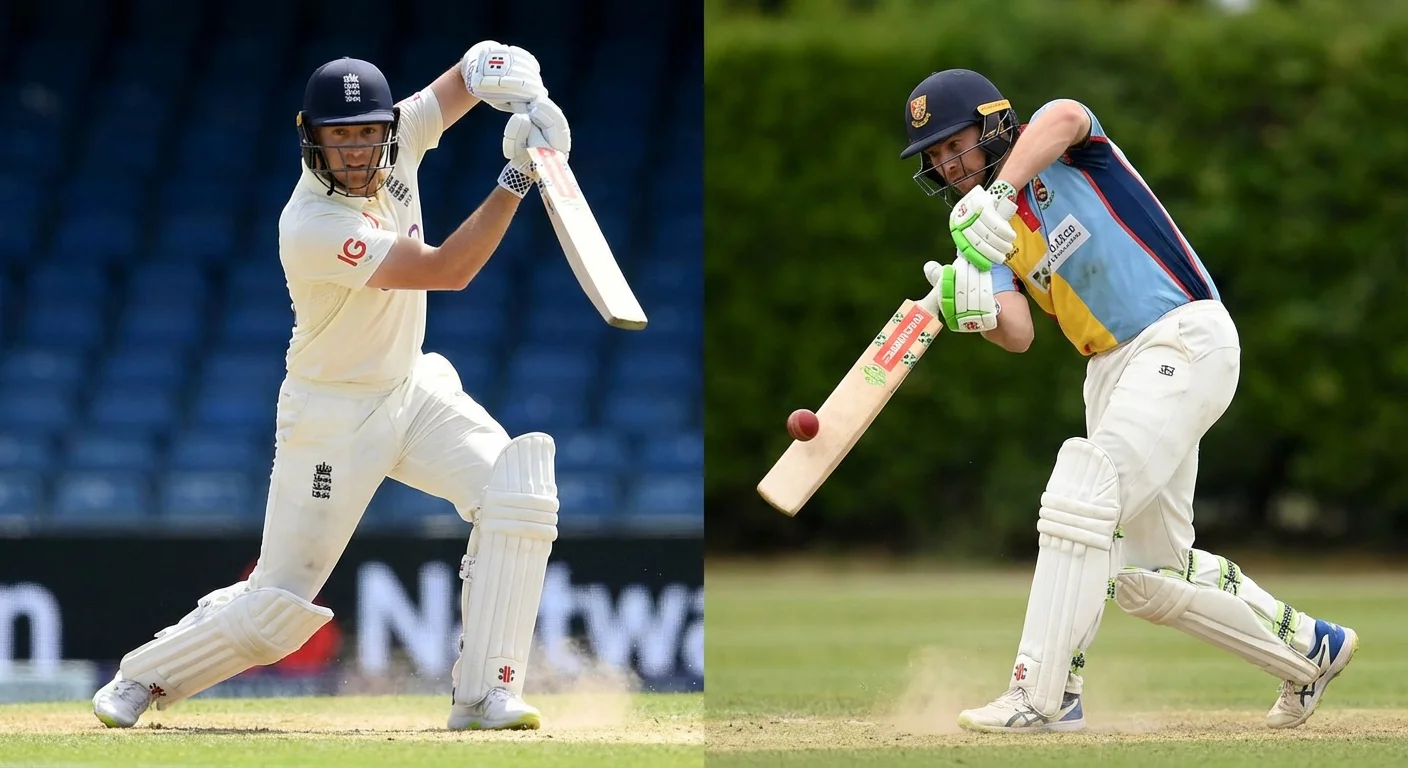
Small margins decide everything here. The ideal contact point for a front-foot cover drive sits a comfortable distance in front of the front pad, with the bat face only slightly open to the line.
Head position matters most. The long-standing cue about getting the head over the ball holds up under analysis: when the head sits directly above or just inside the front knee at contact, the success rate rises sharply. When it drifts well outside the knee — a sign the batter is reaching — edges and misses become far more likely.
Phase 5: The Follow-Through
The follow-through reveals the quality of the stroke that produced it. A clean drive finishes with the bat high, the weight on the front foot and the back foot pivoting on the toe. A short, truncated follow-through usually means the batter decelerated through the hitting zone, from uncertainty or poor balance.
What the Numbers Mean for Your Game
The Elbow Problem
The most common fault is the collapsing front elbow. A consistently low elbow usually points to one of three causes: the bottom hand gripping too tightly, hands starting too low in the setup, or a batter trying to hit the ball hard rather than time it. Each needs a different fix — top-hand-only practice, for instance — which is why treating the cause matters more than correcting the symptom.
The Head Position Fix
If the head drifts outside the line of the front knee, "keep your head still" is rarely the answer. Good coaching asks why it is moving. Is the stride going too far across? Is the stance compromising balance? Is a fear of the short ball pulling the head away? Analysis identifies the pattern; the coach diagnoses the cause.
The Weight Transfer Drill
For sluggish weight transfer, front-foot press drills — stepping into the drive from a deliberately back-weighted start — build the muscle memory for a decisive transfer.
Beyond the Cover Drive
The same framework applies to every shot. The pull has its own optimal shoulder rotation and swing plane; the defensive block is a controlled forward press with its own bat-angle and hand-position parameters.
What pose analysis brings is not a replacement for the coaching eye but an expansion of it. A coach in the nets can watch ten things at once; software can measure many more. Together they form a feedback loop that speeds up improvement.
Fundamentals, Validated
The fundamentals good coaches have always stressed — a still head, a decisive stride, a high elbow, balanced weight transfer — find firm support in analysis. They are not aphorisms but measurable, trainable parameters, tracked session by session, giving a player concrete evidence of progress.
The cover drive is an art. The mechanics underneath it can be measured.